JM Toys Ltd.
Brand
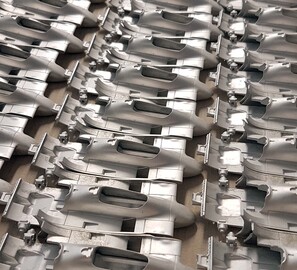
Many collectors will know the well known sight of a wall of 1:18 scale model cars covering many tables at the major toy fairs, and adjacent to this formidable array is an equally substantial display of the very best in quality white metal handbuilt models.
Those who have obtained their models from JM Toys for some years will know that it was founded by John Martin, and John’s story deserves recounting here. John hails from an engineering background, having commenced a five year apprenticeship with GEC Marconi in Portsmouth at the tender age of 16. There he developed his model and tool making skills, including working on prototypes of satellites and torpedoes. He left Marconi at 21 to improve his skills at Plessey, and then at 25 had an opportunity to work for himself. He founded three companies, J Martin, Toolmakers, MDM Engineering, and a third making agricultural spraying equipment. It was his tool making company, though, which cleared the path towards toys, as this company made tools for the production of Airfix kits, Palitoy model railways, and similar work for other toy companies.
Subject ID: 81191
MoreMany collectors will know the well known sight of a wall of 1:18 scale model cars covering many tables at the major toy fairs, and adjacent to this formidable array is an equally substantial display of the very best in quality white metal handbuilt models.
Those who have obtained their models from JM Toys for some years will know that it was founded by John Martin, and John’s story deserves recounting here. John hails from an engineering background, having commenced a five year apprenticeship with GEC Marconi in Portsmouth at the tender age of 16. There he developed his model and tool making skills, including working on prototypes of satellites and torpedoes. He left Marconi at 21 to improve his skills at Plessey, and then at 25 had an opportunity to work for himself. He founded three companies, J Martin, Toolmakers, MDM Engineering, and a third making agricultural spraying equipment. It was his tool making company, though, which cleared the path towards toys, as this company made tools for the production of Airfix kits, Palitoy model railways, and similar work for other toy companies.
John recalls how he found old toys when he was holidaying in Devon at Shaldon, where he had a flat for the family just by the little zoo. He found himself at the nearby Bairnscroft hotel listening to a chap from Birmingham, who owned a model shop. He was then intrigued by the model shop in Teignmouth which displayed a wide range of model railway items. He became hooked, wanted to both collect, and to become further involved, so he bought a company making the controllers, and then acquired the Fleetline Model Company, owned by Brian Parks, which made white metal model miniatures for model railways, and railway accessories in N gauge, such as farm animals, fencing etc.
He transferred his skills from managing engineering work to counting toy sheep on the kitchen table, as he and his wife found themselves responsible for packing the sets of animals and other accessories.
On November 9th 1979, John opened Cowplain Models, near Waterlooville, Hampshire, stocking mostly model railways, kits and some obsolete diecast models. During the following 5 years, he consolidated his position in the toy field by purchasing first the stock and then the freehold of Tony Collett’s model shop In Portsmouth which also specialised in model railways. He finally sold the shop to Chris Hitchin in 1984, and whilst he had an agreement with Chris not to trade in competition locally, John began trading at a few toy fairs elsewhere around the country. At the Salisbury swapmeet he met David Angel, who traded as Angel’s Autos, owning both a collection of about 20 American cars, and also a scrap yard in Dorset. Meanwhile, John became attracted to the new Brooklin Models range, impressed by their weight and strength, and remembers with frustration how he was still gathering his knowledge on Brooklin, as he let 2 Brooklin models without windows go very cheaply at a swapmeet, not realising that these were 2 very early models finished in this way at the Canadian factory. On his travels John began collecting Pathfinder models, and met Pete Kenna of Kenna Models. As his knowledge grew, he was approached by Richard West, the first editor of Model Collector, to write a column on white metal models. He declined, but his collection was photographed at home for the magazine.
He also travelled to the Brussels swapmeet at Woluwe, where on one occasion he found some odd coloured Brooklins, and wrote about his find in the Model Collector magazine.
Imagine his surprise when he got a call from John Hall, supremo at Brooklin, quizzing him on where he obtained them. It became clear that these models had been removed from a workbench at Brooklin Models. John Hall was happy for John to keep the models, and as a result a strong friendship was formed.
The pattern is becoming clear, as John expands his knowledge, trading in white metal and his personal collection, so friendships are made. He travelled to Canada and the USA, visiting the Canadian Toy Collectors Society annual show, and buying collections of Brooklin models along the way. He believes at this stage he had amassed one of the biggest collections of Brooklins in the world. Indeed, John’s collection, and those of John Hammick and David Angel, were the source of all the listings in the first Brooklin Model Guide. Roly and Doug McHard, of Somerville Models, were also amongst the friends he made along the white metal trading route, as he was stocking large quantities of models from all the key British and foreign manufacturers.
Throughout this period of expansion in the model world, John continued to own his engineering company, only closing it finally in 1992.
As a result of his long term diagnosis of diabetes, John became involved with the British Diabetic Association, and realised he could make a difference through his involvement with model cars. John organised with Brooklin Models to produce a special BRK 31x Pontiac sedan delivery as an ambulance, had 500 made, and donated all the profits to Portsmouth hospital and the BDA. He has been amazed at the generosity of collectors that made this possible. Further projects included a special Lledo model which raised £30,000 for the Portsmouth hospital, and funded groups of diabetic children in need to enjoy holidays on the Isle of Wight. Other manufacturers also supported the fund raising, including Pathfinder Models with special colour variants on its Morris ‘J’ van, and Pete Kenna with a special Standard Vanguard pick up.
By this time, JM Toys had become one of the biggest distributors of white metal models world wide. Certainly, John was regularly ordering a substantial number of each colour of the Pathfinder Models as they were released. This increasingly close link to the specialist makers led to special models, such as those in the Viscount Range in the 1970s. These white metal models came about through a joint partnership with Pathfinder owners Jeff and Sue Sharrock. Sadly, the range had to stop at 2 models as Jeff’s ill health meant curtailing all but the mainstream Pathfinder range.
JM Toys would handle all the major white metal ranges, importing Durham Classics, and were main retailers for Brooklin Models, Scale Racing Cars, Kenna Models, Western Models, RAE Models and Somerville Models, together with Minimarque43, Pathfinder Models, Illustra, Scale Model Technical Services and many others.
Nowadays, John feels that the market continues to be reasonably buoyant, but sales are more web based than at toy fairs. He feels this is a backward step, as traditionally, it has been a pleasure to share with customers face to face the weight, definition and detail that white metal handbuilt models offer. His flagship range has always been Brooklin, which includes Lansdowne, but surprisingly, may not have done. John explained to us that prior to the Lansdowne ranges’ launch, John Hall of Brooklin had been proposing that John might commission Brooklin to make a range of British cars. John Hall’s main interest was always American cars, and the European connection was satisfied by the joint venture with Eddie Anderson which created the Robeddie range. John discussed the idea with John Hammick, and together they felt they could enter into a business arrangement with Brooklin, on the basis of approximately 150 pieces of the each model.
They got as far as researching the possible subjects, concluding that the range should be called Westminster, and would be launched with an Austin Westminster. However, when John Hall suggested that 1,000 items would be the batch supplied, they realised that this was too big a risk. A year later, Lansdowne was born and launched ‘in house’.
Subject ID: 81191
Subject ID: 81191